Edges of Belonging: Design for Everyday Exchange in Melusi
Prize(s):
WINNER 2026 ARCHITECTURE / Residential Architecture | ARCHITECTURE / Urban Planning
School / University Name:University of Pretoria
Lead Designer(s) Name(s):Humayra Akhalwaya
Professor Name(s):Mr Jason Oberholster, Professor Carin Combrinck
Photo Credit:Humayra Akhalwaya
Project Location:Melusi, Pretoria, Gauteng, South Africa
Design Status:Concept
Project Description:
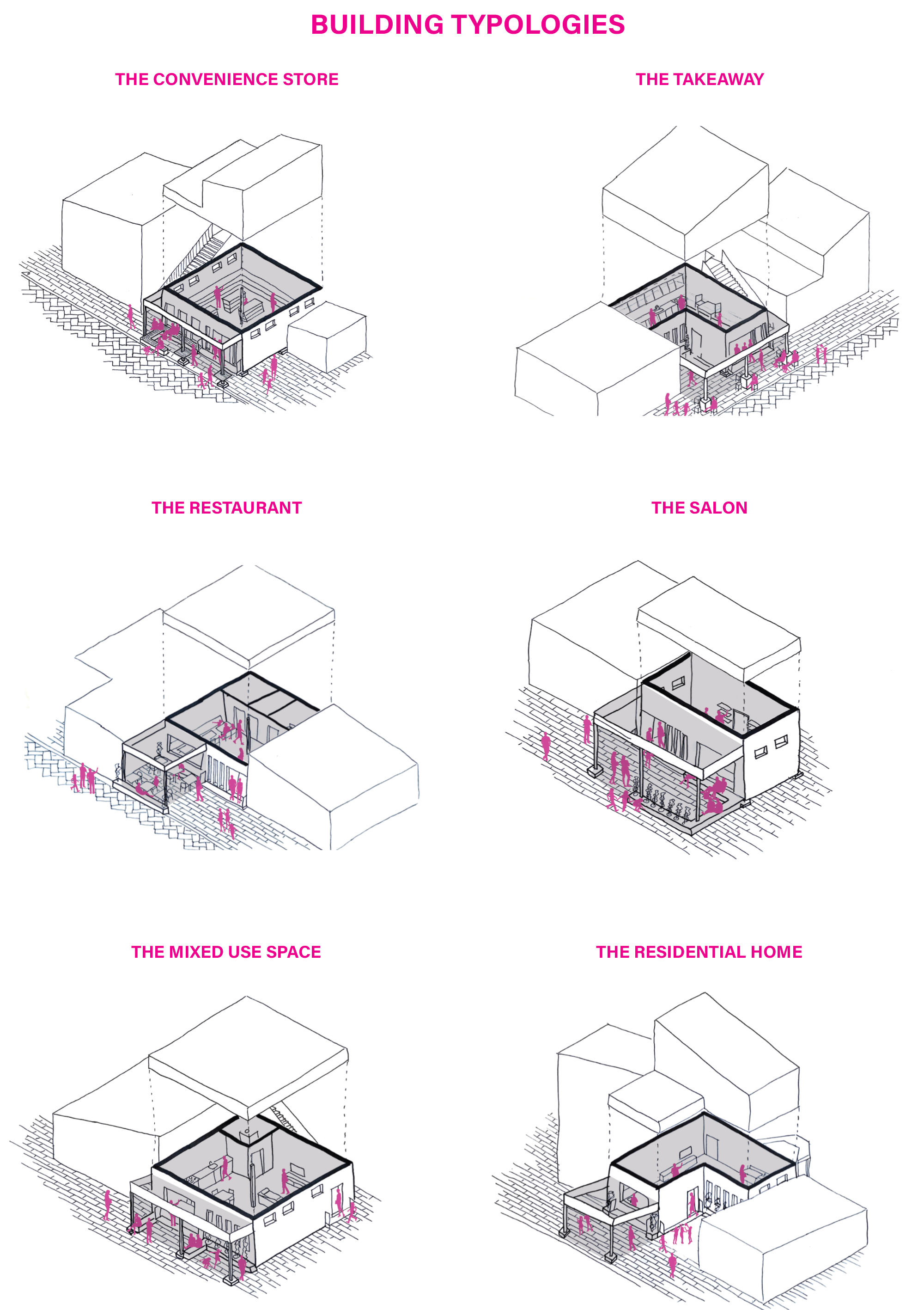
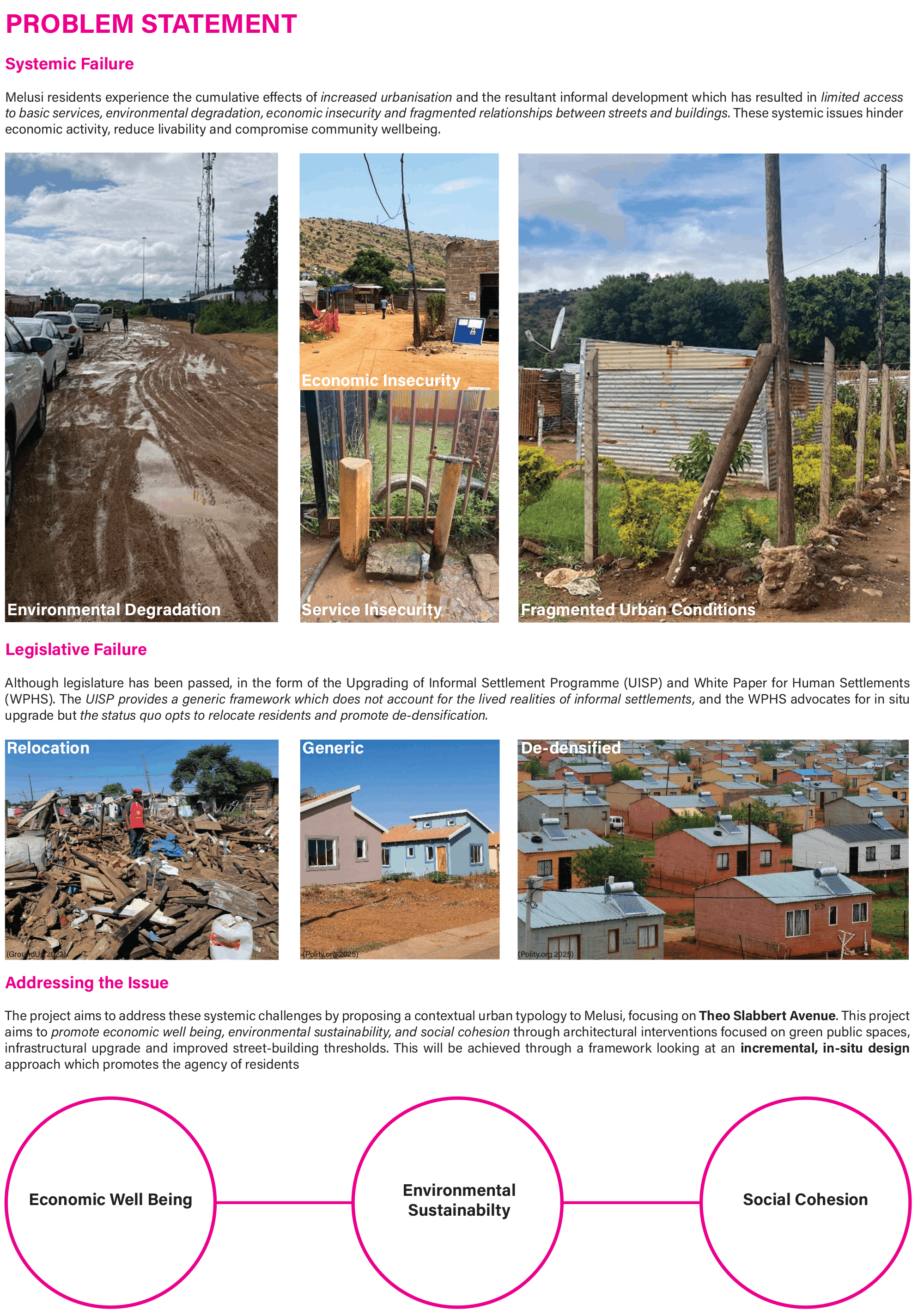
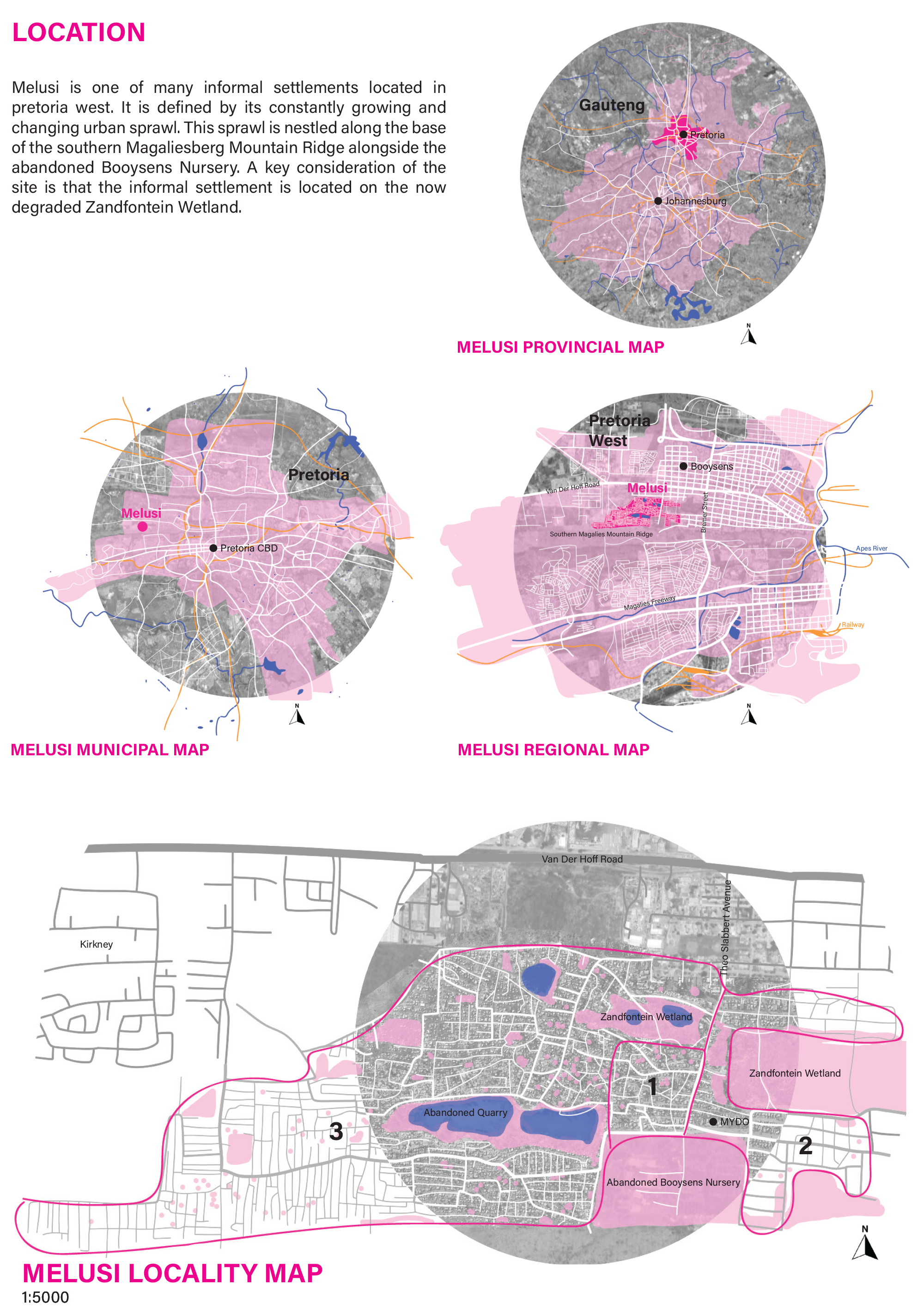
This project explores the development of a contextual street-based urban typology in Melusi, an informal settlement located in Pretoria West. The focus is on Theo Slabbert Avenue which presently is defined by poor infrastructure, unsafe pedestrian conditions, and a lack of clear thresholds between buildings and the public realm. These limitations constrain mobility, reduce safety, and hinder everyday interactions between residents, shop owners, and the wider community. The project focuses on residents and informal entrepreneurs who rely on the street for movement, trade, and connection. The current urban form does not synergistically satisfy these needs. In response the project proposes an architectural and infrastructural upgrade that positions the street as both a public space and a framework for economic and social life.
This project explores the development of a contextual street-based urban typology in Melusi, an informal settlement located in Pretoria West. The focus is on Theo Slabbert Avenue which presently is defined by poor infrastructure, unsafe pedestrian conditions, and a lack of clear thresholds between buildings and the public realm. These limitations constrain mobility, reduce safety, and hinder everyday interactions between residents, shop owners, and the wider community. The project focuses on residents and informal entrepreneurs who rely on the street for movement, trade, and connection. The current urban form does not synergistically satisfy these needs. In response the project proposes an architectural and infrastructural upgrade that positions the street as both a public space and a framework for economic and social life.
Project Innovation / Specification:
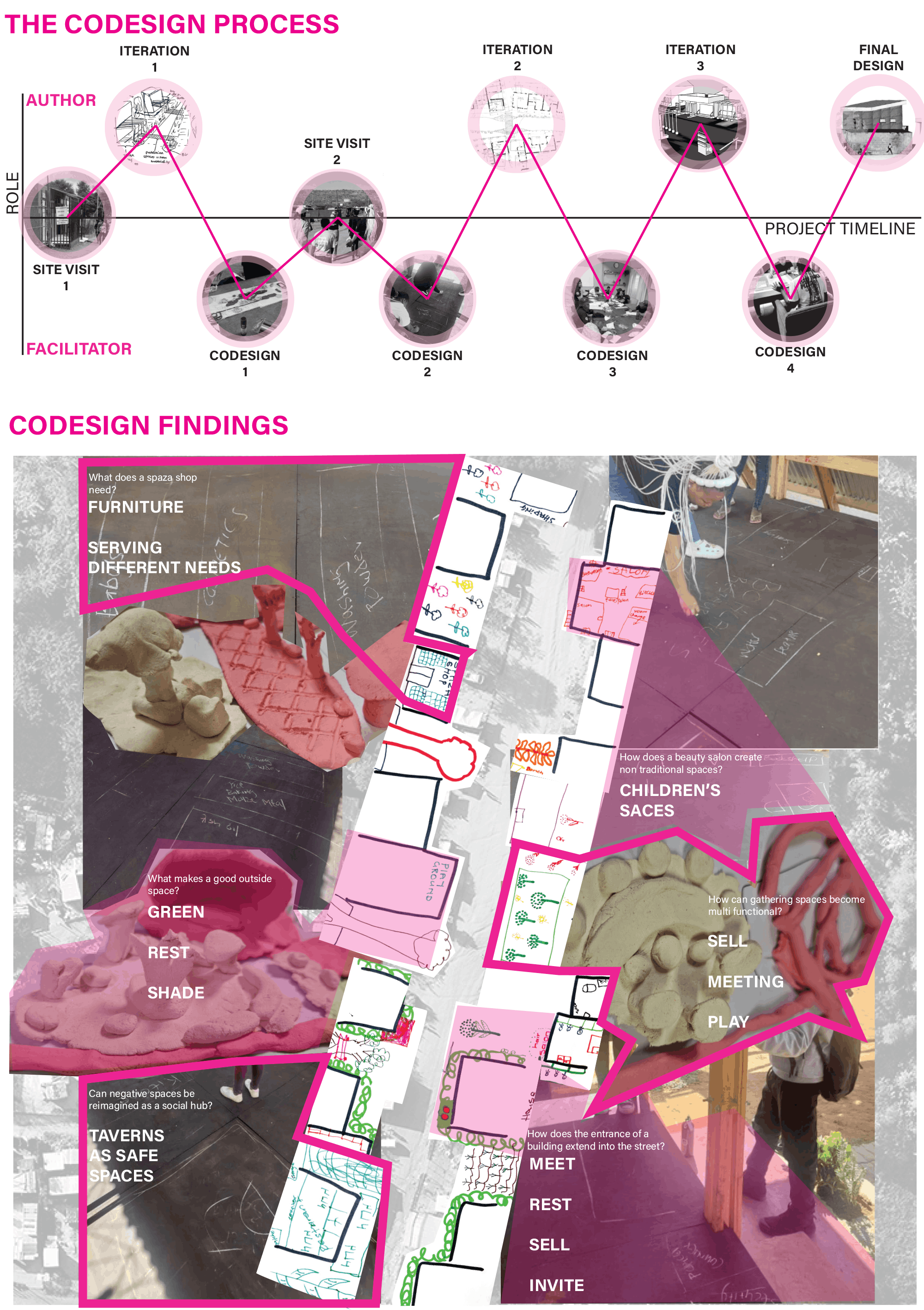
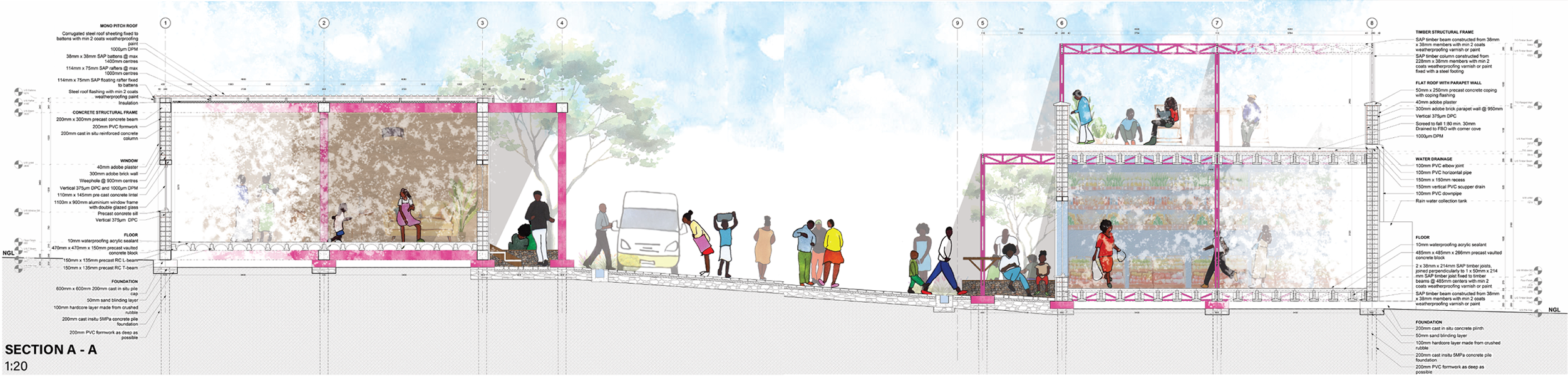
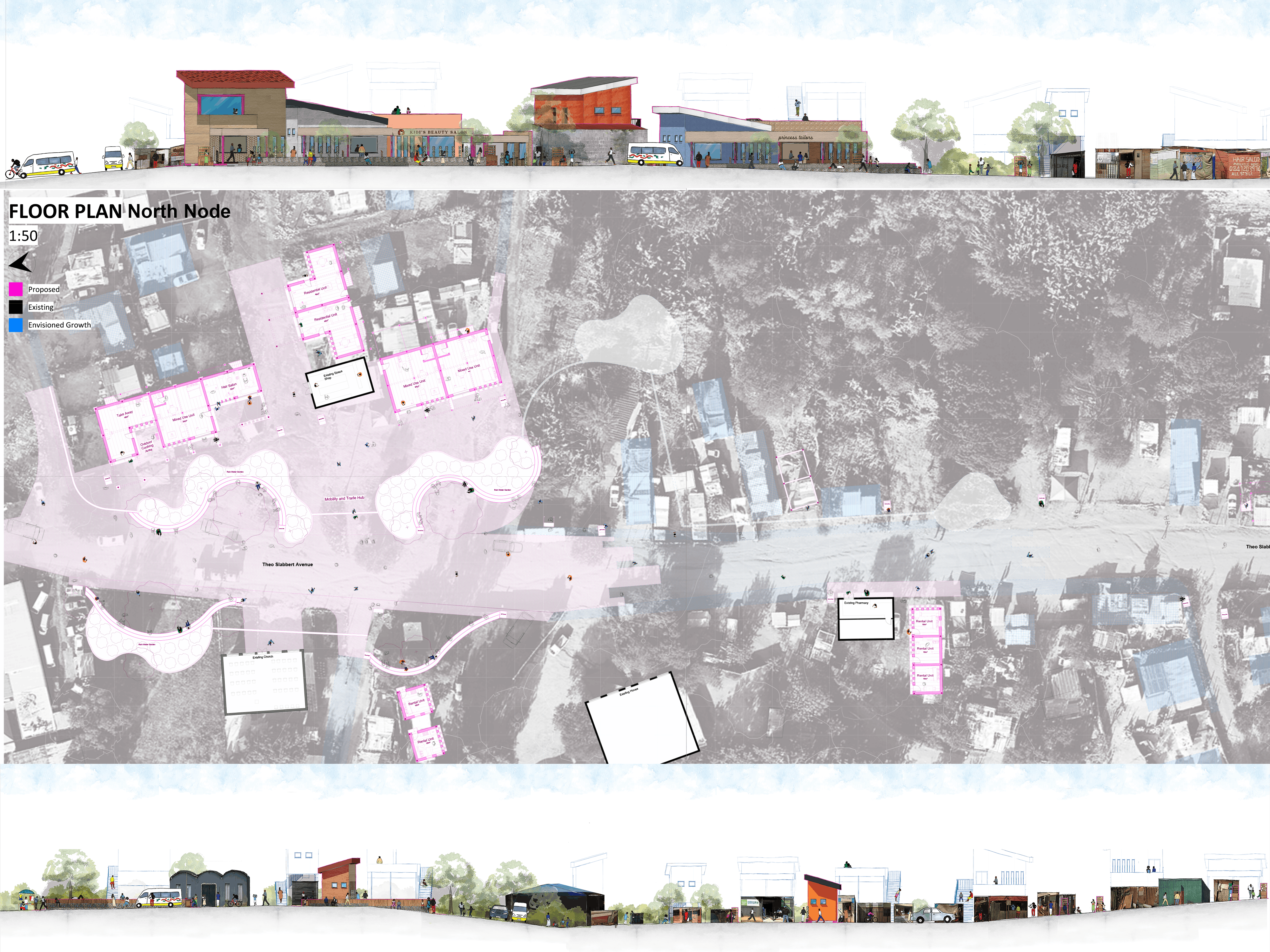
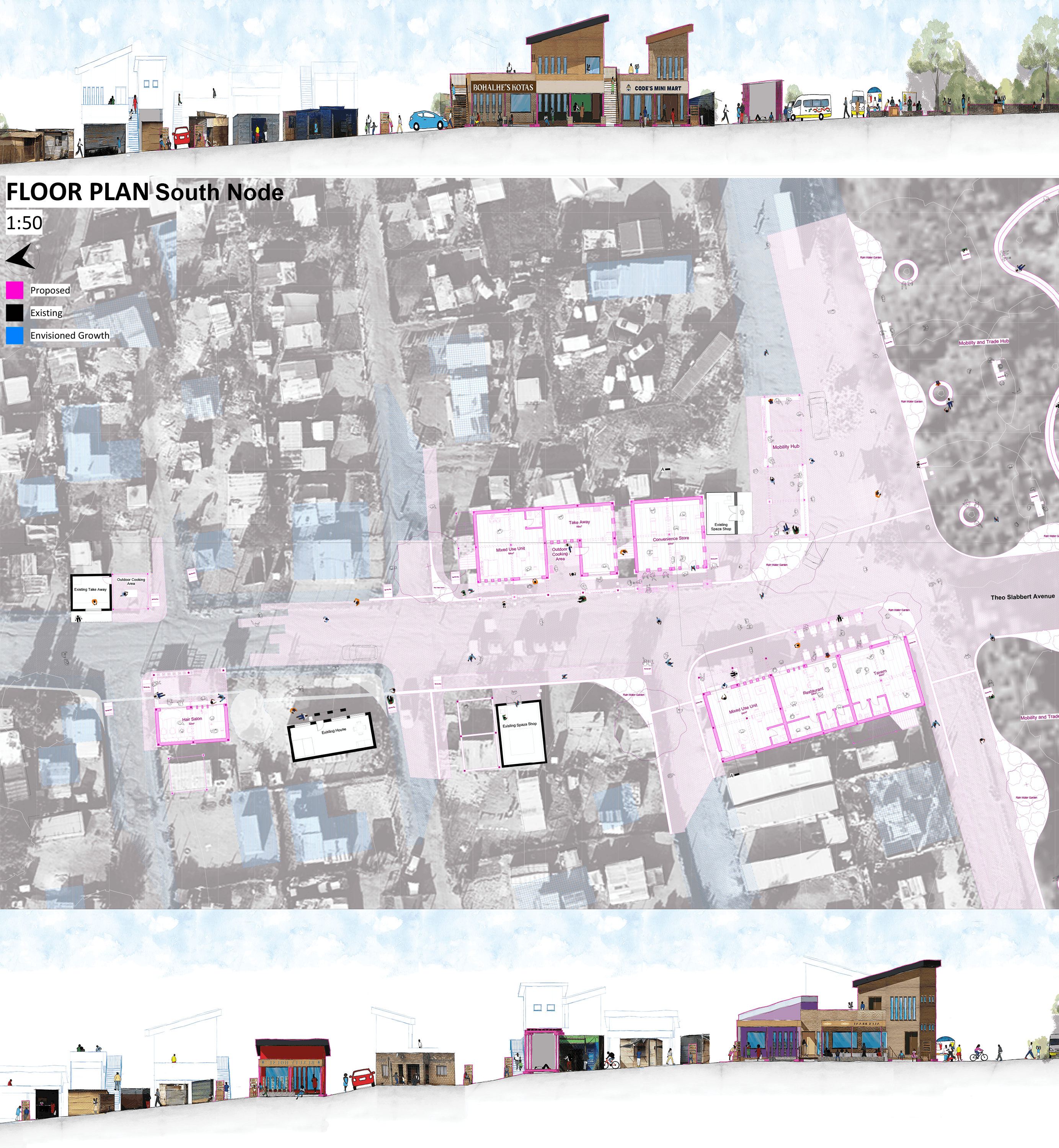
The design process consists of co-designing with members of the community in order to imagine the street through both tacit and expert knowledge. The design aims to enable safer, more interactive environments through pedestrian routes, active thresholds and a series of nodal points, through incremental in situ upgrade. The nodes act as anchors through encouraging interaction between people and reinforcing the street’s role as a shared resource. Rather than imposing a formal order, the proposal supports and strengthens spatial practices already present in Melusi. It positions infrastructure not only as a technical fix but as a tool for agency. In doing so the project highlights the potential of architectural design to meaningfully contribute to informal settlement upgrading by working with, rather than over, the realities of place.
The design process consists of co-designing with members of the community in order to imagine the street through both tacit and expert knowledge. The design aims to enable safer, more interactive environments through pedestrian routes, active thresholds and a series of nodal points, through incremental in situ upgrade. The nodes act as anchors through encouraging interaction between people and reinforcing the street’s role as a shared resource. Rather than imposing a formal order, the proposal supports and strengthens spatial practices already present in Melusi. It positions infrastructure not only as a technical fix but as a tool for agency. In doing so the project highlights the potential of architectural design to meaningfully contribute to informal settlement upgrading by working with, rather than over, the realities of place.
Project Sustainability Approach:
The project aligns most directly with: SDG 11: Sustainable Cities and Communities- It positions the street as a form of inclusive urban infrastructure, improving safety, accessibility, and everyday liveability while responding to the spatial realities of informal settlement conditions. SDG 10: Reduced Inequalities- Through a co-design approach, the project addresses inequality by recognising community knowledge as central to the design process. SDG 9: Industry, Innovation and Infrastructure- At the same time, it proposes an incremental and adaptable model of infrastructure that reframes design as both a technical and social system, capable of supporting more equitable and contextually grounded urban development
The project aligns most directly with: SDG 11: Sustainable Cities and Communities- It positions the street as a form of inclusive urban infrastructure, improving safety, accessibility, and everyday liveability while responding to the spatial realities of informal settlement conditions. SDG 10: Reduced Inequalities- Through a co-design approach, the project addresses inequality by recognising community knowledge as central to the design process. SDG 9: Industry, Innovation and Infrastructure- At the same time, it proposes an incremental and adaptable model of infrastructure that reframes design as both a technical and social system, capable of supporting more equitable and contextually grounded urban development
Local and Regional Impacts of the Project:
At a local scale, the project improves everyday conditions along Theo Slabbert Avenue by enabling safer pedestrian movement, supporting informal trade, and creating shared spaces that strengthen social interaction and community agency. The incremental, in-situ approach works with existing spatial practices, enhancing both the usability of the street and the dignity of those who occupy it. At a regional scale, the project begins to position itself as a replicable model for informal settlement upgrading, demonstrating how infrastructure can operate as both a social and technical system in addressing broader issues of inequality, access, and sustainable urban development.
At a local scale, the project improves everyday conditions along Theo Slabbert Avenue by enabling safer pedestrian movement, supporting informal trade, and creating shared spaces that strengthen social interaction and community agency. The incremental, in-situ approach works with existing spatial practices, enhancing both the usability of the street and the dignity of those who occupy it. At a regional scale, the project begins to position itself as a replicable model for informal settlement upgrading, demonstrating how infrastructure can operate as both a social and technical system in addressing broader issues of inequality, access, and sustainable urban development.

Lead Designer(s) Name(s):Humayra Akhalwaya
Profile Description:
As an architect and researcher, I work at the intersection of design justice, participatory practice, and spatial agency. My work is rooted in the belief that architecture must extend beyond form-making to engage meaningfully with the social, political, and environmental contexts that shape it. Driven by critical reflection, social accountability, and long-term impact, I strive to reimagine architectural practice as a tool for transformation, one that listens, adapts, and ultimately serves.
As an architect and researcher, I work at the intersection of design justice, participatory practice, and spatial agency. My work is rooted in the belief that architecture must extend beyond form-making to engage meaningfully with the social, political, and environmental contexts that shape it. Driven by critical reflection, social accountability, and long-term impact, I strive to reimagine architectural practice as a tool for transformation, one that listens, adapts, and ultimately serves.
Environmental Practices:
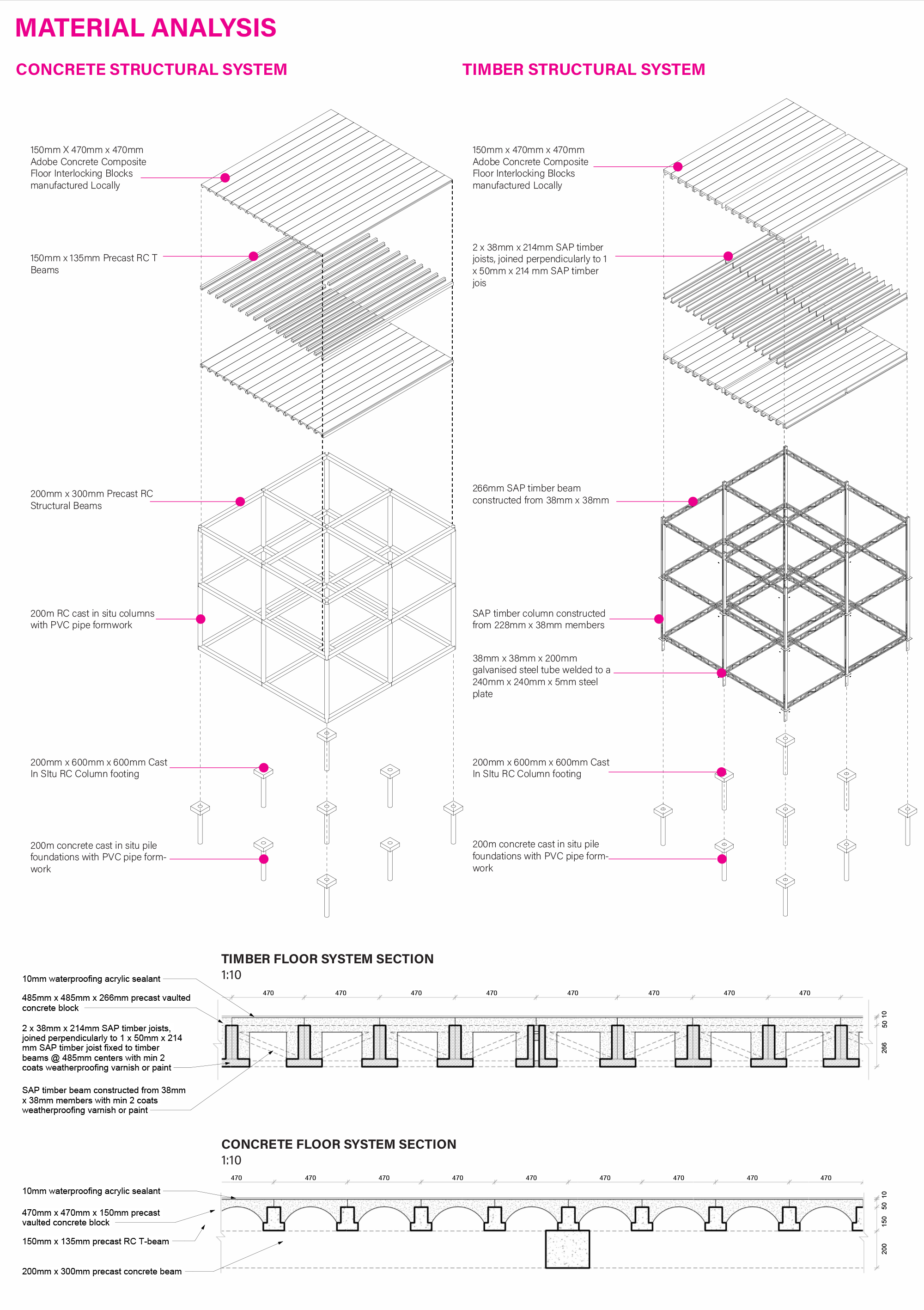
My approach to environmental practice is grounded in contextual and socially responsive design, where sustainability is integrated into the everyday life of the settlement rather than treated as a separate system. I focus on adaptive strategies that combine ecological performance with human experience through green spaces, rainwater gardens, hydroponics, passive solar design, and biodegradable local materials. The aim is to create environments that are resilient, inclusive, and responsive to both social and environmental realities.
My approach to environmental practice is grounded in contextual and socially responsive design, where sustainability is integrated into the everyday life of the settlement rather than treated as a separate system. I focus on adaptive strategies that combine ecological performance with human experience through green spaces, rainwater gardens, hydroponics, passive solar design, and biodegradable local materials. The aim is to create environments that are resilient, inclusive, and responsive to both social and environmental realities.
Previous Awards Won:
The Urban Citizen Award, University of Pretoria, Department of Architecture, 2025
The Urban Citizen Award, University of Pretoria, Department of Architecture, 2025